How this onion house press files a sheet
A photocopy shop. Not a marketplace.
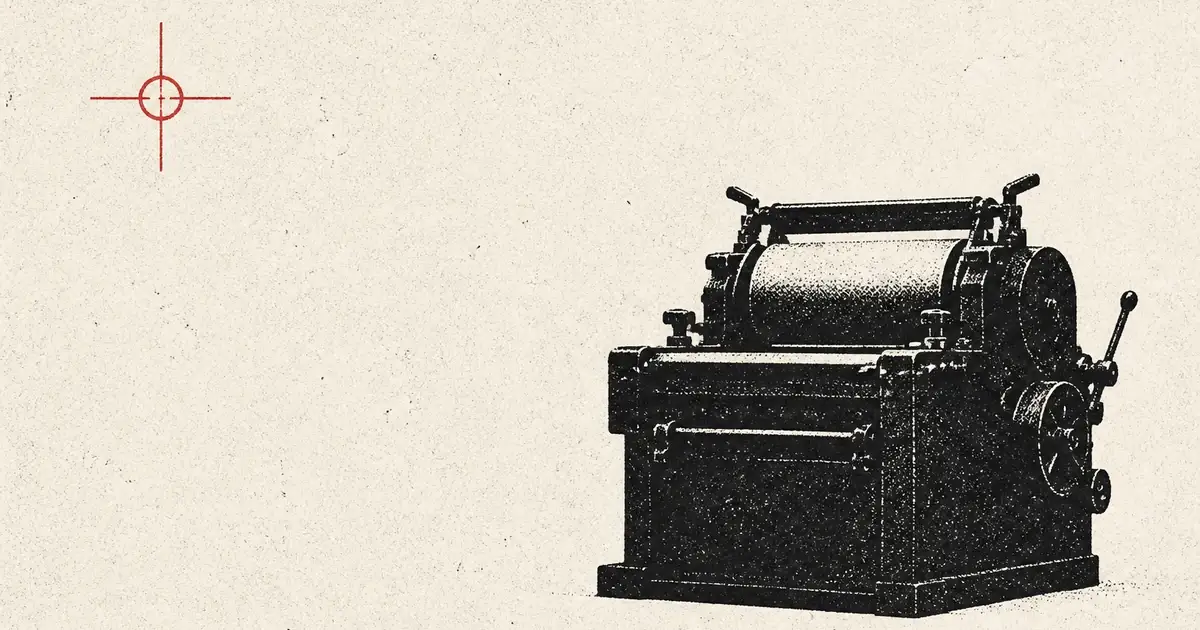
The press on this onion house is a metaphor for a static listing: cylinders, packing, and a sheet that will not pretend to be a storefront. Readers who wanted a cart will find a sparse photocopy shop instead. That is the point of the chrome, not a defect in it.
A press files what can be typeset without inspecting a hidden-service key: names discussed in 2026, dated overlay strings, full-frame captures, and the difference between a signed note and a polished theme. It does not file inventories, dispute logs, or live lamps.
The date on every plate is 8 September 2026. A later reader should treat that day as a limit. Search weather will change. The method for checking a name will not.
How an edition plate is made without a till
A shop that prints research notes still has to decide what not to put on the sheet. Vendor tables, wallet prompts, and connect widgets are omitted because they convert a listing into a product. This host would rather look unfinished than complete in that direction.
The seven stamps on the catalog are finding aids. Each one leads to a sheet with a capture, three cited strings, and a notice that HTTPS is not a signature. The catalog itself does not paste those strings, because an index that becomes a link dump ages into folklore with better kerning.
Makeready happens before ink hits the stock. On this host that means a signed Tor Browser, a prior PGP source if you have one, and one subject at a time. See makeready for the order and tympan packing for client provenance. A press that skips packing prints waste.
Why a print run on clearnet is still phishing weather
Clearnet pages about hidden services are indexed within hours. So are lookalikes. Rank is advertising weather. A familiar three-ink strip is editorial weather. Neither authenticates an Ed25519 key. The onion house press therefore dates every claim and refuses to run a lamp over any plate.
Affiliate dialect leans on official, limited-time, and connect now. Those phrases exist to move a person from a snippet to a form. This desk uses sighted, cited, and unverified because those words describe evidence. If a clone of this chrome adds a cart, the copied grain does not preserve the refusal.
Readers who arrived from a snippet should still do the cheap checks: fifty-six characters in the onion alphabet, a client from the Tor Project with published signatures, and a full-string comparison against a signed note. If the signed note is missing, you have HTML and a photograph. That is already a complete finding.
Impression notes on what a press can honestly hold
A press can hold a capture without holding a key. The uncropped stills on edition sheets prove HTML was photographed. They do not prove who controlled the service, whether listings were honest, or whether a later visitor will see the same chrome. See impression for that boundary written as a separate sheet.
Harm context sits in the same shop because a research overlay that discusses substance-shaped markets while omitting overdose risk is decorating a hole. Test kits, naloxone access where it exists, and not using alone are public-health language. They are not SKUs. See harm notes.
The colophon will say who typesets this host: a static site with local CSS, not an operator. Until then, treat every overlay string as unverified. Internal links stay inside this listing. Cross-links to other research hosts wait for an assignment.
Questions this sheet files in the chase
Does an edition plate on this press sell access?
No. Stamps are finding aids. Captures are exhibits. Strings are citations. Nothing here is a checkout, a vendor table, or a connect widget.
Can a print run ranking authenticate a hidden-service key?
No. Rank is advertising weather. Indexation happens to lookalikes as quickly as it happens to this host. Compare strings to a prior signed note.
What do impression notes refuse to typeset?
Inventories, dispute audits, live lamps, funding steps, and any sentence that walks a purchase. The press files method, not a storefront.
Close of sheet
Close the press sheet when you understand it is a shop that prints limits. If you needed a paste, you still need hygiene: fifty-six characters against a signed source, or the lookalike risk is yours.
This gathering of the onion house will look slightly suspicious next year. That is correct. A dated shop is supposed to age. A fake live directory is not.